

Peruvian culture is a complex and dynamic expression of human history, shaped by thousands of years of development, encounters between civilizations, and the continuous interaction of diverse groups. It is not only the product of ancient traditions but also of contemporary transformations that give it vitality in the present. When people reflect on what defines Peruvian culture, they encounter an extensive set of practices, values, and knowledge systems that transcend time and geography. This culture is not static; it is living, adaptable, and constantly enriched by both its ancestral roots and modern global connections.
The concept of Peruvian culture can be approached from multiple perspectives. It includes the symbolic universe of rituals, languages, and beliefs; the material expressions of art, architecture, and crafts; and the intangible aspects such as values, norms, and collective identities. It represents a synthesis of millennia of interaction between human beings and their environment, between native Peruvians and external influences, and between tradition and innovation.
You might be interested: How to Prepare for a Multi-Day Trek – Gear, Training, and Survival Tips

Historical Foundations of Peruvian Culture
The foundation of Peruvian culture rests on civilizations that flourished long before the arrival of Europeans. Archaeological evidence demonstrates that Peru was one of the cradles of ancient culture in the Americas. Civilizations such as Caral, Chavín, Paracas, Nazca, Moche, and later the Incas, contributed essential elements that shaped collective identity. The continuity of cultural practices over thousands of years illustrates the depth and resilience of this heritage.
Peru Inca culture holds a particularly prominent role in this history. The Inca Empire represented a peak of political, social, and economic organization in pre-Columbian America. Its achievements in agriculture, urban planning, astronomy, and communication systems established a legacy that continues to influence Peruvian culture today. Agricultural terraces, irrigation canals, and the quipu system demonstrate an advanced capacity for adaptation and innovation.
The arrival of the Spanish in the 16th century introduced profound changes. Colonization brought the imposition of new institutions, religion, and language. However, instead of erasing pre-existing systems, it produced a complex cultural fusion. This encounter generated syncretic practices that combined European and indigenous elements, visible in religion, festivals, architecture, and daily life. Thus, Peruvian culture embodies both continuity and transformation, resilience and renewal.
Linguistic Diversity
Language is a central element of Peruvian culture. Spanish is the dominant language today, but the linguistic landscape is far more diverse. Indigenous languages, particularly Quechua and Aymara, have maintained vitality across centuries. Additionally, dozens of Amazonian languages reflect the diversity of native Peruvians living in the rainforest. Each language represents not only a tool of communication but also a worldview, a repository of knowledge, and a vehicle of cultural identity.
The coexistence of multiple languages reveals the plural character of Peruvian culture. While Spanish often functions as the language of public institutions and communication with the outside world, indigenous languages sustain ancestral traditions and local identities. This multilingual reality strengthens cultural diversity and demonstrates the persistence of traditions in the face of external pressures.
You might be interested: Unforgettable Unique Travel Experiences in Peru
Religion and Spirituality
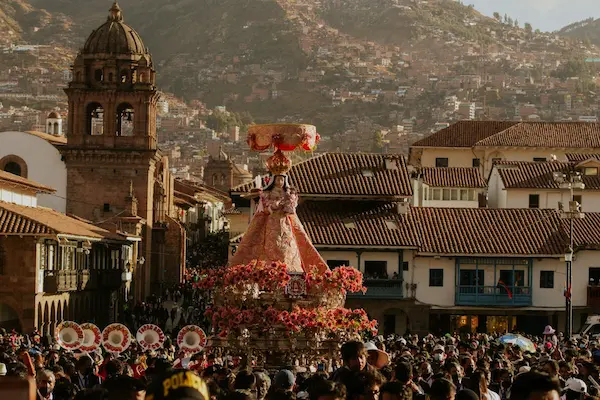
Religion in Peru is characterized by syncretism. Catholicism, introduced during colonization, became dominant but did not completely displace pre-Hispanic beliefs. Instead, a process of integration occurred, in which symbols, rituals, and sacred spaces of the Inca and other cultures merged with Christian practices. This fusion created a distinct religious identity that continues to shape Peruvian culture.
Traditional spirituality, especially among native Peruvians, retains elements of reverence for nature and the cosmos. The concept of Pachamama (Mother Earth) reflects an enduring worldview in which human beings are interconnected with the natural environment. Rituals of offering, agricultural ceremonies, and celebrations of natural cycles reveal the persistence of pre-Columbian values within modern society.
Social Organization and Values
Peruvian culture is also defined by its social structures and values. Family plays a central role, functioning as the main unit of solidarity and transmission of customs. Beyond the nuclear family, extended family networks and community ties strengthen collective life. Solidarity, reciprocity, and respect for elders are values deeply embedded in society.
The principle of ayni, inherited from Peru Inca culture, reflects the importance of reciprocity and mutual aid. It is still practiced in rural communities, where collective labor benefits all members. This value system highlights the emphasis on cooperation and collective responsibility, contrasting with individualistic models prevalent in other parts of the world.
Material Culture
The material expressions of Peruvian culture are vast and varied. Architecture, textiles, pottery, and metalwork illustrate centuries of creativity and adaptation. Pre-Columbian civilizations developed architectural styles that remain admired today, from monumental temples to urban centers. The integration of form and function demonstrates a sophisticated understanding of engineering and aesthetics.
Textiles produced by native Peruvians are another essential component. Patterns, colors, and techniques transmit symbolic meanings and social identities. These creations are not merely decorative but carry messages about origin, community, and worldview. Similarly, pottery and metalwork express both functional needs and artistic sensibilities.
Gastronomy: What Is Peruvian Cuisine?
Food is a key component of Peruvian culture. The question what is Peruvian cuisine opens the door to one of the most remarkable aspects of national identity. Peruvian cuisine represents a synthesis of indigenous ingredients, colonial contributions, and global influences. It is recognized internationally for its diversity, innovation, and flavor.
Staples such as potatoes, corn, and quinoa originate in Peru and continue to be central to the diet. The use of chili peppers, beans, and tropical fruits reflects the ecological diversity of the country. Spanish colonization introduced wheat, rice, and livestock, which transformed local diets. Later migrations from Africa, China, Japan, and Italy added new techniques and flavors.
Peruvian cuisine illustrates the adaptability and richness of Peruvian culture. It integrates multiple layers of history into dishes that are consumed daily. From the highlands to the coast and the rainforest, each region contributes unique preparations. This culinary diversity reflects not only ecological variation but also the creativity and resilience of native Peruvians and later populations.
Arts and Aesthetics
Artistic expression is another pillar of Peruvian culture. Pre-Columbian civilizations left legacies of monumental art, ceramics, and textiles that continue to inspire admiration. These forms were not only aesthetic but also symbolic, reflecting religious beliefs, cosmologies, and social structures.
Colonial art introduced European techniques but was transformed through local interpretations. Religious paintings, sculptures, and architectural styles exhibit syncretism, combining European and indigenous elements. In the modern era, Peruvian art embraces both tradition and innovation, with literature, painting, and music reflecting the multiplicity of identities.
Music and dance are essential to Peruvian culture. They embody regional diversity and historical continuity. Indigenous instruments, rhythms of African origin, and European melodies merged to create a varied musical landscape. Dance, as an extension of music, functions as a vehicle of collective identity, celebration, and symbolic representation.
Education and Knowledge Transmission
Education has played a decisive role in sustaining and transforming Peruvian culture. In pre-Columbian societies, knowledge was transmitted orally, through ritual, and through material practices such as textiles or the quipu. These methods preserved cosmological and practical information.
Colonial institutions imposed Western educational systems, but indigenous traditions persisted. Today, education in Peru faces the challenge of integrating modern demands with cultural diversity. Bilingual education, recognition of indigenous knowledge, and promotion of cultural identity are key elements of current policies. In this way, Peruvian culture continues to evolve while maintaining ties to ancestral wisdom.
Identity and National Consciousness
The construction of a national identity is inseparable from Peruvian culture. Despite regional differences, there is a shared sense of belonging rooted in history, traditions, and values. Symbols such as the flag, the national anthem, and collective celebrations contribute to national cohesion.
At the same time, cultural diversity is recognized as a source of strength. Native Peruvians, descendants of colonial populations, and immigrant communities all contribute to a plural identity. This diversity is not a weakness but rather a foundation for resilience and creativity.
Globalization and Modern Life
Peruvian culture is not isolated from global processes. Globalization, migration, and technology have transformed many aspects of daily life. Urban centers demonstrate increasing interaction with international trends, while rural communities adapt to external pressures without abandoning their traditions.
The challenge of modern Peruvian culture is to balance preservation with innovation. Cultural policies, heritage conservation, and educational initiatives aim to protect traditions while fostering participation in global networks. The adaptability of Peruvian culture ensures its continuity in a rapidly changing world.
You might be interested: Festivals in Peru September: Celebrate Culture and Tradition

What Are 5 Cultural Facts About Peru?
Understanding Peruvian culture requires identifying structural elements that define its character. Five key cultural facts illustrate the depth and diversity of this identity:
- Diversity of Origins
Peruvian culture is built on a long continuum of civilizations, from early agricultural societies to the consolidation of Peru Inca culture and the subsequent colonial fusion. This historical layering makes it one of the most complex cultural systems in the Americas. - Multilingual Heritage
Although Spanish is the most widely spoken language, Quechua, Aymara, and more than 40 Amazonian languages reflect the plurality of native Peruvians. This multilingualism highlights both resilience and the coexistence of diverse identities within a single nation. - Syncretic Religious Practices
Peruvian culture integrates Catholic traditions with pre-Columbian beliefs, generating a distinctive spiritual framework. Practices related to Catholic saints often coexist with ancestral rituals that honor natural forces and deities. - Regional Variation
The culture is not homogeneous. The coast, Andes, and Amazon each present distinctive practices, foods, and customs that together form a national identity. This regional diversity strengthens the sense of belonging to a plural yet cohesive culture. - Global Recognition of Cuisine
A defining characteristic of modern identity is gastronomy. The answer to what is Peruvian cuisine lies in its fusion of indigenous staples with European, African, and Asian influences, making food a universal representation of Peruvian culture.
What Is Important to Peruvian Culture?
Several structural components can be considered essential to Peruvian culture:
- Family and Community Bonds
Peruvian culture emphasizes the centrality of family as a transmitter of values, customs, and identity. Beyond the nuclear family, extended kinship networks create resilience and collective support.
- Respect for Ancestral Traditions
Continuity of traditions, particularly those derived from Peru Inca culture, demonstrates a strong cultural memory. Rituals, crafts, and symbolic practices are preserved as sources of identity and pride.
- Connection with Nature
Native Peruvians maintain practices that reveal a worldview centered on balance with natural cycles. The environment is not only a resource but also a sacred element within Peruvian culture.
- Linguistic and Artistic Expressions
Language, music, dance, and crafts are vital channels of identity. These forms are essential for transmitting collective memory and cultural values across generations.
- Gastronomy as Cultural Expression
Food is not only nutrition but also a symbol of heritage. The continued recognition of what is Peruvian cuisine shows how gastronomy functions as a central aspect of cultural expression.
What Are Some Cultural Norms in Peru?
Cultural norms represent shared behaviors and expectations that guide daily life. Within Peruvian culture, several norms are particularly relevant:
- Hospitality and Social Warmth
Peruvian culture values cordiality toward visitors. Interpersonal relations emphasize openness and hospitality as markers of respect and community belonging.
- Collective Celebrations
Participation in communal events is expected. Whether religious or secular, gatherings reinforce social ties and demonstrate respect for tradition.
- Deference Toward Elders
Elders occupy an important position as transmitters of knowledge. Native Peruvians, especially in rural areas, embody this principle by granting elders significant authority in cultural continuity.
- Flexible Perception of Time
In certain communities, time is not conceived rigidly but in relation to social and natural rhythms. This norm reflects a worldview distinct from industrialized models.
- Bilingual Communication
In multilingual regions, shifting between Spanish and indigenous languages is a common norm, reflecting the adaptability and plural character of Peruvian culture
What Are Peruvian Traits?
Peruvian culture is reflected in a series of traits that define collective identity:
- Resilience
Historical challenges, from colonization to modern transformations, have been met with adaptability. This resilience is a defining trait of Peruvian culture.
- Pride in Heritage
There is strong collective identification with Peru Inca culture and with pre-Columbian civilizations more broadly. Pride in history reinforces continuity across centuries.
- Creativity and Innovation
Artistic, culinary, and social innovations highlight creativity as a permanent trait. The global prestige of what is Peruvian cuisine exemplifies this cultural capacity.
- Community Orientation
Social practices emphasize reciprocity, cooperation, and solidarity. These values, inherited from native Peruvians, remain visible in collective traditions.
- Spiritual Worldview
Peruvian culture integrates material and spiritual aspects of life. Connection with nature, respect for ancestors, and integration of spiritual practices reflect this worldview.
Regional Dimensions of Peruvian Culture
Peruvian culture cannot be understood without analyzing regional diversity:
- Coastal Culture: Shaped by maritime resources, urban development, and centuries of exchange. Coastal regions emphasize gastronomy, commercial activity, and modern lifestyles integrated with historical traditions.
- Andean Culture: Rooted in Peru Inca culture and earlier civilizations. It is characterized by strong indigenous identities, persistence of Quechua and Aymara languages, and agricultural practices adapted to high-altitude environments.
- Amazonian Culture: Native Peruvians in the rainforest maintain cosmologies and traditions closely tied to ecological diversity. Amazonian cultures illustrate the integral link between environment and identity.
Knowledge Systems and Worldview
Knowledge systems are another foundation of Peruvian culture. Indigenous knowledge of agriculture, astronomy, and medicine illustrates the sophistication of pre Columbian societies. These systems continue to inform modern practices, particularly in rural communities.
The worldview of native Peruvians emphasizes harmony between human beings, nature, and the cosmos. This holistic perspective contrasts with reductionist models of modernity and highlights the distinctive contributions of Peruvian culture to global discussions on sustainability and spirituality.
National Identity and Collective Memory
Peruvian culture contributes directly to national identity. Shared symbols, languages, and traditions create cohesion among diverse populations. National holidays, commemorations, and institutional practices reinforce this collective memory.
At the same time, the acknowledgment of diversity within unity is essential. Native Peruvians, descendants of colonial populations, and migrant groups together form a collective identity that is plural and inclusive. This duality unity within diversity defines the resilience of Peruvian culture.
Conclusion
Peruvian culture represents one of the most intricate and resilient cultural systems in the world. It integrates ancient traditions, colonial legacies, and modern innovations into a coherent identity that values diversity, continuity, and creativity.
By analyzing what are 5 cultural facts about Peru, what is important to Peruvian culture, what are some cultural norms in Peru, and what are Peruvian traits, we gain a structured understanding of its essential dimensions. The integration of Peru Inca culture, the role of native Peruvians, and the centrality of what is Peruvian cuisine illustrate the multiple layers of this cultural reality.
In the present, Peruvian culture continues to adapt to global transformations while preserving its heritage. It remains a living testimony of human creativity, resilience, and capacity for synthesis. Its traditions, history, and modern life form a legacy not only for the people of Peru but for humanity as a whole.
